Wednesday, January 03, 2007

The housing bubble is set to burst

Probably the first and only guy to call the real estate industry's bluff.

Rediff.com,

He's just listed a fund at the AIM stock exchange in the UK - the fund, which controls around 4 per cent of Unitech's land bank, has raised �362 million (Rs 3,168 crore).

Unitech's 10,500 acre-plus land bank makes it one of the largest real estate firms in the country - according to investment firm UBS, this can translate into 400 million square feet of commercial and residential space.

While the group is primarily into residential complexes today, it is a 40 per cent partner in the high profile 40,000-acre project with Indonesia's Salim Group in West Bengal, which includes SEZs, integrated townships, expressways and even two bridges over the Hooghly and Haldi.

Unitech's MD Sanjay Chandra is of the view that a lot of the enthusiasm over hotels and malls, especially in tier II and III cities is unwarranted, as is the rush to build luxury apartments. Excerpts from an interview with Surajeet Das Gupta and Nayantara Rai:

Are you happy with the AIM listing?

Yes, we've listed Unitech Corporate Parks and have got a valuation of Rs 3,168 crore (Rs 31.68 billion) - the company has a portfolio of 197.5 acres and will build up 21.5 million square feet space in six IT parks across the country. This portfolio represents approximately 4 per cent of our total land bank in India.

Apart from the valuation we've got, what's more important is that the world's leading funds and financial institutions have invested in us. I've been told this is the second or third largest real estate float in the UK. That's quite an achievement.

But why did you list at AIM?

One of the reasons is that we needed to create a platform for REITs [Real Estate Investment Trusts]. We have created a development fund, which can now be sold overseas.

What is the size of your current land bank?

As per our disclosure in September this year, our land bank was 10,400 acres. After that, we have acquired 77 acres in Chandigarh, 100 acres for a housing project in Greater Noida, and another 25 acres in Noida.

Are you looking to grow from M&As?

Not at all. We are only interested in adding value to our projects.

What about your foray into hospitality?

We've learnt that it's not a good idea to be in a hurry to sign management contracts with hotel operators. Unlike others who have forged joint ventures with hotel operators, we will be more flexible and neutral in our approach. Therefore, we will require different partners in different locations.

At present, we have three hotels in Gurgaon, two in Kolkata and one at Noida. One of the hotels in Gurgaon will be a luxury hotel and we are in talks with potential partners.

Why is that you don't participate in hotel auctions?

All our hotels will be a part of a mixed-use development - we don't believe in stand-alone projects. So land agencies auctioning these isolated sites do not fit in with our overall strategy.

Besides that, people are paying exorbitant rates that I just don't understand. It doesn't make sense to pay Rs 450 crore (Rs 4.5 billion) for a hotel site in Dwarka. You can make a Ritz Carlton in Singapore for that amount.

What are your plans for retail? Everyone seems to be entering it...

We don't plan to be retailers. Retail has very low margins, and being in the real estate business, I'm used to high returns.

We are in the business of developing retail destinations. We have had a soft opening in Rohini (west Delhi) and our mall in Noida will open in two and half months. There are obviously many more plans on the radar.

Will you tie up with any retailer for your malls?

No, we don't want to limit ourselves. We want to do business with everyone. So why should we get into exclusivity clauses with any retailer?

Do you perceive a property bubble in the near future?

I think some pockets are heading for trouble. The realty run-up in the tier-II cities in north India are outrunning the employment opportunities available there. And today, all of us developers are chasing the upper middle class.

There is all this talk of Ambala, Rudrapur and Haridwar and so on. But how many job opportunities coupled with high purchasing power will actually become a reality in these towns?

What about all the talk of IT/ITES companies starting operations in tier-II cities?

So what? Even if they do, there will still be trouble. These companies will probably have business process outsourcing outfits in these towns and about 90 per cent of the employees won't be able to afford housing. The rest may be supervisors who may have the purchasing power, but 10-15 per cent of them would be living with their parents.

Hospitality will be another troubled sector. Those buying sites at exorbitant prices haven't factored in the fact that room rates will fall. A few years from now, the supply will increase considerably, and hotels will no longer be able to command today's room rates.

Even retail is heading for trouble. Retailers cannot be expected to make profit from the rentals charged by developers today. Rentals in authorised shopping complexes skyrocketed after the MCD (Municipal Corporation of delhi) sealing drive in the capital. This directly affects the retailer's business.

How much rent do you charge for your malls?

In Noida, we leased about 80 per cent of the mall before building and the average rate was Rs 120 per square foot. The last 20 per cent was rented out at an average of Rs 300 per square foot.

In Rohini, we started leasing after the construction was complete. While we were targeting Rs 60-70 per square foot, we actually ended up charging Rs 170 per square foot.

Is the market in Gurgaon slowing down?

We feel there is an overdose of luxury housing in Gurgaon. So we have made a conscious effort to stay away from that and concentrating on the upper-middle class segment. The average size of our houses is 2,000 square feet and these are available for Rs 80-90 lakh (Rs 8-9 million). Even that is probably too much.

Is there speculation in the market still high?

No, it's much better. From 70 per cent last year, I think, it is down to 10 per cent. Buyers now seem to be selling after possession. This is good news for us in the industry.
Earlier a person would buy a house at the time of the launch - with discounts offered which would vary from developer to developer - and sell in just a few months. By the time the construction was completed, a house or apartment had been resold five to 10 times.

Realty cos raise Rs 4k cr in 2006

PREITI SHARMA SHAHANE

TIMES NEWS NETWORK[ TUESDAY, JANUARY 02, 2007 03:10:16 AM]
BANGALORE: There couldn’t have been a happier year for Indian realtors. Riding on stellar valuations, the real estate industry has jumped 10 places from last year to emerge at the No 2 slot by contributing as much as 17% to the total funds mobilised through public issues — initial public offerings (IPOs) and follow on public issues (FPOs) — this year.

Indian real estate developers and infrastructure companies have raised Rs 3,994 crore in IPOs and FPOs this year as compared to a mere Rs 216 crore last year.

Two out of five issues of over Rs 1,000 crore each this year emerged from the real estate category. Prithvi Haldea, MD, Prime Database, said, “Led by Parsvnath Developers (issue size — Rs 1,090 crore), Lanco Infratech (Rs 1,067 crore) and Sobha Developers (Rs 569 crore), the share of the realty/infrastructure sector stood at Rs 3,993 crore through 12 companies out of the total Rs 24,141 crore that public issues mobilised in 2006. The year also witnessed the second highest-ever mobilisation in the history of the Indian capital market.”

According to Prime, energy companies dominated with a 35% share of this year’s tally at Rs 8,374 crore through just three issues. The year also witnessed the largest-ever IPO — Cairn India — for Rs 5,260.79 crore which propelled the energy sector to the numero uno position.

The realty juggernaut shows no signs of slowing down in the year ahead. As per PRIME, issues in the realty/ infrastructure sector that have already received or are awaiting Sebi approval include the big-ticket Omaxe which is estimated to raise Rs 1,500 crore, Gammon Infrastructure Projects (Rs 375 crore), Akruti Nirman (Rs 350 crore), C&C Constructions (Rs 150 crore) and Gremach Infrastructure Equipments & Projects (Rs 59 crore). Ahluwalia Contracts is expected to raise about Rs 250 crore through its FPO.

About 20 other IPOs/FPOs are in the pipeline for 2007. They include the much-delayed DLF Universal, which will look to raise Rs 12,000 crore, Simplex Infrastructure, Ansal Properties & Infrastructure, Mantri Developers, Emaar Properties, Puravankara Projects, Goel Ganga Group, IJM India Infrastructure, IVRCL Prime Urban Developers, JMD Promoters, Kumar Builders and Peninsula Land.

Rents go through the roof in India’s top cities

Indian express article

Reuters

Changing archaic laws will free up a lot of property in India’s financial capital, but it still won’t meet demand

MUMBAI, January 3 : UP a flight of creaky wooden stairs, real estate agent Hemant Surve guides a prospective renter around a damp two-bedroom apartment overlooking the sea in the country’s financial capital.
Real estate boom to continue: AssochamReal deal: Digital and transparent Foreign funds adding to realty boom: ParekhWhen prices crash, hidden home loan clause may hauntIt won’t bring down the roof

Flaking paint and dilapidated toilets leave his client, an American expatriate, distinctly unimpressed but Surve says its dysfunctional plumbing and dour colour scheme is all she’ll get for her budget of $2,500 a month — plus bills.

“Many are willing to pay anything for a flat like this,” Surve says as he gestures at a bare sitting room, whose arched windows open on to a heap of ugly road construction material and huge cranes.

As global firms flock to India to tap opportunities in its burgeoning economy, premium residential rents in cities like Mumbai and New Delhi are going through the roof. While residential rents have gone up across the board, they have surged 31 per cent in the last quarter in Mumbai’s top-end areas like Nariman Point, named as one of the world’s 10 most expensive locations in a recent CB Richard Ellis survey.

Tenants drawn from banks, IT companies, securities traders and headhunters are driving the market in the city, property dealers say.

In New Delhi, upmarket southern suburbs have seen rents appreciate 30 per cent in each of the last two quarters.

“Values in Delhi will remain buoyant as there will be no substantial supply in the next 12-15 months,” said a consultant with real estate firm Knight Frank. “The demand-supply situation in the premium segment is the same in Mumbai and New Delhi.”

In Bangalore, home to major IT firms, property prices have risen as much as 50-60 per cent in the past six months, but have since fallen and stabilised at a rise of about 15 per cent after new construction met part of the huge demand.

The high-end property market in India’s financial capital Mumbai is witnessing a bizarre drama, where rents for some two-bedroom apartment can either match those in New York or Tokyo, or cost only a few dollars.

The cause is a six-decade-old rent control law — framed to insulate tenants from unscrupulous landlords — which millions of renters use to hold a large chunk of prime property, paying rents at 1940s prices.

The politically popular law has been extended more than 20 times and currently applies to roughly 60 per cent of buildings in the city centre. Landlords, who can’t raise rents or redevelop their assets without tenants’ permission, have watched helplessly as market prices have soared and their properties have disintegrated.

“A change in the rent laws will free up a lot of premium properties,” said Sandeep Sadh, chief executive of online real estate firm www.realestatemumbai.com. But he adds that even then it wouldn’t be enough to meet the demand in the residential segment.

The pressure on the high-end property market has forced companies and individuals to look at Mumbai’s northern suburbs, but poor connectivity to the rest of the city is a problem.

-Krittivas Mukherjee

editor@expressindia.com

Real estate pump up

Everyone with any real estate background is pumping up real estate.

Moneycontrol.com
By Kamiya Jani

One sector, where demand does not seem to be going down, is real estate. Several reports suggested that property prices would cool off post Diwali and all those who wanted to buy a house were waiting for this period. Now that Diwali is over, Moneycontrol takes stock of what is really happening. Have property prices finally started to cool down?

Price check

“Prices are still on the rise and we don't see them coming down soon. Developers have purchased plots at expensive rates and will sell them at higher rates,” says Sanjeet Narain, managing director, Narain Corporation. He also adds that the demand in the market is ever increasing and the supply is less. So prices will be on a rise for a while, however, they may stabilize after 12 months.

Experts say that the infrastructural development like sealinks, flyovers, highways and also malls coming up in India has been the major reason for prices to go up.

Property consultant, Ramesh Nair points out that in many markets, be it residential or commercial, major price increase has happened in the 12 months since May 2005. “Prices are rising even today but not as much as then. It is not going to be a drastic increase as we saw in the first quarter of 2006.”

In certain pockets of India, prices have grown upto 200%. However, Nair says that prices could fall in certain over-heated pockets of the city but the fall may be just marginal. He cites the following reasons for the correction being only marginal:

* Speculators leaving the market
* Rental rates going down
* Interest rates going up
* Demand increasing in certain parts of the country

Should you buy a home to live in now?

Narain suggests, “Someone who is planning to buy a home should not wait any longer as prices will keep going up. He should go ahead and buy it now.” He recommends that in ready possession properties, one should invest in the suburbs, as the demand is more there, hence chances of a price rise are higher.

“In Mumbai, over the past 30 months, prices at suburbs have increased from 40% to 130%,” says Sandeep Sadh, CEO, Mumbaipropertyexchange.com. From Andheri to Borivili, Kurla to Mulund and location surrounding BKC will be on a peak.

Therefore, if you are planning to buy a home to live in, and you have a budget big enough to buy it in the city's central location, understand that you may not get high appreciation. If you are looking at home, along with getting the benefit of real estate boom, buy a home in suburbs.

Ravindar K Vanwari, Director of Investment, AAkarshna Realtors, makes an interesting point. He says, “Property seekers may go ahead with their plan but I suggest that they should buy home with original booking only and not by paying premium on it.”

Original booking price means the price at which the builder is selling the flat even before the building is ready and is yet under construction. This price is generally less than the ready to move in price. For instance, original booking price of a certain complex in Bhandup was Rs 2,500 but now, on completion, it has gone up to Rs 4,000 and is expected to go further up. Original booking price is generally low due to many reasons, one of which could be the risk that the builder may or may not finish the building.

However, if you are planning to buy a ready apartment, try to bargain to get the closest price at which the developer sold the flat when it was under construction as against the price he quotes for a ready apartment.

Nair recommends that you do an in-depth analysis before buying property, since price appreciation will vary from area to area. Look at the price trend in the last few years in the particular area, infrastructural development in the city and the location, future attraction and also how the property looks from a long term investment point of view. This means that schools, connectivity, stations, depots, SEZ, highways, malls, entertainment centers so on and so forth should be not more than half and hour's distance from home.

Sadh says, “We ask all our clients to follow one policy. When a man is looking for a house, his first priority should be for kids, second should be for wife and third should be himself.”

Therefore, make sure that:

* Your home should be at a good proximity to your kid’s school. Since he is going to be in the same school for about 12-15 years, it may not make sense if your kid has to spend time to travel far off.
* Hospitals, markets, bus depots and railway stations are other important necessities you must look for.
* You should be ready to travel for work but do not compromise on the above-mentioned areas. You may change your job in the next three years or your office might get shifted to some other place. Therefore, buying a home near your workplace should not be the priority in your wishlist. However, if you are lucky to get a right one, then off course, what can be better than that?
* You should also preferably look for amenities like swimming pool, sports club, gym etc. either within the residential complex or near by. All these facilities will help your family for recreation and refreshment.
* Opt for higher floors since that helps to keep away from dust. You also get to enjoy all climatic conditions in India, be it winter, rainy or spring.

Property as an investment

Since experts believe that prices will still be on the rise, investing in real estate won’t be a bad idea. But Narain recommends one must invest only in under construction properties, as the prices of under construction properties are lesser than the ready ones and will increase on possession, hence better profit on possession. One can buy at a cheaper rate, enjoy appreciation and then sell it at a higher rate when the building is ready for possession.

By investing in a property at an early stage, you also get an option of choosing the floor, sight facing, and various other amenities.

Nevertheless, one must look at the real estate sector as a long-term investment. Vanwari avers, “A person who holds his property for 15-20 years gets more returns than an investor who buys and sells property after every six months. By doing this frequent trading in property, a short term investor may be happier but at the end of 15-20 years, the investor with a long term view will benefit more.” Since every time you buy or sell your property, you may have to pay various taxes like property tax or capital gains tax, the returns may look lucrative but it may not necessarily be.

Nair says, “Investing in land is better than investing in apartments, because yields on apartments have dropped from 5.5% to 4%.” All underdeveloped areas and new townships like Faridabad, Mohali or Noida will give a good capital appreciation in the coming years. But you must also look for connectivity - the place should be well connected to the main city. In this case, quite a many under developed areas are being connected to the urban areas with the help of newly built highways, flyovers etc.

Basically, all prospective buyers should look at peripheral location where infrastructural developments are happening that can be classified as growth corridors of the city.

India's property boom yields high returns

From news.yahoo .com - By Shailendra Bhatnagar

NEW DELHI (Reuters) - Rajan Sharma bought 4,000 square feet of office space on the outskirts of India's capital, New Delhi, for 2,900 rupees ($65) a square foot in 2002 and hasn't stopped grinning since.

Four years later, the 42-year-old consultant regularly gets offers more than three times the price he paid for the same office space as the arrival of foreign players, easy finance and rising incomes fuel a rush for prime real estate.

"It has been a very short but a hugely profitable journey," Sharma, who now runs a property firm, told Reuters.

"Seeing these profits I feel I should have done real estate all my life."

He is not alone.

There are literally thousands of sellers and speculators who have laughed all the way to the bank because of a property boom in New Delhi and its two satellite towns -- Noida and Gurgaon.

The pace has been almost as brisk in many other cities in India.

In Delhi, prices have been pushed even higher by a government campaign to close shops and offices built illegally in residential neighborhoods, adding to already fierce competition for commercial property.

And a spreading underground rail network in Delhi, which will eventually reach parts of Noida and Gurgaon, has spurred property prices along existing and planned routes.

"There is also fundamental and growing demand for office and retail space because of sustained economic activity driven by software companies and branded firms," said Tanaji Chakrabarti of real estate firm Trammell Crow Meghraj.

Delhi and its suburbs are also home to fifth-ranked software services exporter HCL Technologies Ltd. and huge backoffice units of companies such as American Express Co. and Convergys that employ thousands of staff.

The $23 billion software services sector has been one of the biggest consumers of real estate along with changing shopping tastes that are favoring multi-brand malls over neighborhood mom-and-pop shops, said Chakrabarti.

A NEW ECONOMY

Spurring the boom, the government has slashed cobwebs of legislation by allowing 100 percent foreign direct investment in large projects. Stamp duties have been rationalized and reduced, and a policy to set up special economic zones is boosting industrial growth.

Nascent chains such as Pantaloon Retail (India) Ltd. and Reliance Retail Ltd. have lined up multi-billion dollar expansion plans in which the largest component has been set aside for leasing or buying organized retail space.

In addition, companies such as Nike Inc. and Adidas are deepening their presence through franchised operations beyond India's metros to soak up demand from millions in the growing middle class.

"The demand for retail space across India will increase," said Vivek Dahiya, associate director at global property advisor DTZ India. "Certain markets seeing oversupply will see reduction in vacancies."

In Delhi, Gurgaon and Noida alone organized retail space is likely to rise to 14 million sq.ft. by the end of 2007 from 2 million now, he said.

But the sharp rise in commercial rentals in the past three years is hurting growth prospects of organized retail chains, which operate on margins as low as 3-4 percent.

"Rentals are now dramatically higher - by at least 50 percent in a lot of cities," said Kishore Biyani, managing director at Pantaloon. "At these prices we can't sign up new properties."

Biyani, who started retailing in 1997, said annual sales needed to be at least 50 percent higher to offset rising rentals.

In central parts of heavily congested Mumbai city, monthly rentals for discount stores have soared in excess of 125 rupees sq.ft from 55 rupees sq.ft about 2 years ago, said Pranay Vakil, chairman at Knight Frank India.

"This is madness and has little relevance to actual supply and demand factors," Vakil said. "Rentals are now crossing the industry norm of 12 percent of gross sales, making it extremely difficult and unaffordable for retailers."

But even after this rise, monthly retail rentals in prime commercial space or "high street" in Mumbai are low at $11 per sq.ft compared with $24 in Singapore and $80 in Hong Kong, according to data from Knight Frank India.

SERVICES SECTOR

Research firm SSKI forecasts demand for 160 million sq.ft. of commercial real estate over the next 3-4 years, driven primarily by the services sector, which contributes nearly 55 percent of
GDP in Asia's fourth-largest economy.

Similarly, the housing sector is likely to see 15.9 billion sq. ft. of construction by 2010, SSKI said in a recent report.

However risks abound despite runaway gains and could harm short-term demand for residential property.

"The sharp run in property prices over the last 2-3 years and an upturn in the interest rate cycle are the key risks," said Shirish Rane, an analyst at SSKI.

"Commercial and retail properties are threatened by the trend of rising rentals which impact profitability."

Prices of prime residential property in central Delhi have soared more than 75 percent over the past two years thanks to demand from a growing tribe of millionaires and a law that limits the number of floors that can be constructed.

All this euphoria has also spilled onto the stock markets where the real estate stocks have been among the top performers thanks to scarce supply of quality paper.

Initial public offerings of firms such as Parsvnath Developers Ltd. have seen huge demand and the stock listed, in November, at an 83 percent premium to the issue price of 300 rupees.

($1 = 44.61 rupees)

Tuesday, January 02, 2007

Losing air by Sucheta Dalal

Losing air
01 Jan, 2007

It is an indicator the property bubble is beginning to go flat when inquiries for new properties decline and doubts are cast over so-called deals that had pushed prices into the stratosphere. Questions are being raised about the veracity of a newspaper’s report heralding the ‘record-breaking’ Rs 73,000 per sq feet deal for a South Mumbai apartment. While many in the property market deny such a deal, a more charitable version insists the sale occurred, but the buyer paid an exceptional price for personal reasons. The newspaper didn’t mention the price quoted was on a carpet area basis. Since all newly constructed property has a 40-45 per cent mark up (what are known as super-built up area) it leads to a huge price difference in for newly constructed properties. Sources also say insisting on a particular flat entails another mark up of anywhere between 10 and 20 per cent, depending on the seller’s demands. Once adjusted for these factors, the price looks less stratospheric. So there’s consensus that Rs 73,000 is by no means a new benchmark for Mumbai apartments. Markets sources say irrational prices paid for specific properties in Mumbai can never be considered a benchmark price.

Awry AIM

Another issue worrying realty developers looking to raise large chunks of premium-priced public money is the performance of companies recently listed on London’s AIM (Alternative Investment Market). Prices of three of the top Indian stocks fell below their issue price within a day of listing and continue to remain subdued. So far, 11 Indian companies have raised $1.2 billion from AIM in record time; almost all are trading at a discount. Realty companies love the AIM because the fund raising process is tremendously fast and requires much fewer disclosures. Although global investment interest in Indian realty companies has been high, there is worry aggressive pricing by the front-runners could ruin the chances of those to follow. Higher interest rates and the sharp rise in realty prices has already forced many Indians to drop plans to acquire or upgrade existing homes and the impact is apparent in fewer inquiries for new constructions. All this could impact fund raising plans of realty developers in the coming year.

You can track the hiranandani ticker on yahoo finance as HIRC.L and Raheja's Ishaan Real estate as ISH.L

Hot property destinations in 2007

From MonceyControl.com

A booming economy, easy availability of loans and plenty of projects to choose from are perhaps some of the reasons for the property market shining bright. Year 2006 has come to an end and if you're waiting for the right time to buy some nice cozy place under the sun, Moneycontrol gives you a lowdown on the areas across the country that hold the most promise and the reasons as to why they hold high growth potential.

According to Sajeet Narain, Managing Director, 'Narains Corp' International Properties, all Tier I cities will continue to remain a hot favourite in 2007 too thanks to the influx of foreign fund, multinational companies, FDI, better infrastructure among others.

But then if Tier I cities are out of your reach you could consider investing in the surrounding locations. Adds Narain, "A good place to invest in any Tier I city, is the location surrounding the city and the suburbs, as these areas historically have been in demand in most developing international cities.

"For instance the location surrounding Hyderabad is in demand as the rates in the city has increased. India's largest IT special economic zone is also going to be set up in the outskirts of Hyderabad which will help the residential demand to grow in the surrounding areas."

Sandeep Sadh, CEO Mumbai Property Exchange.com also believes that a lot of the growth will be driven by developments in the IT and ITES sectors.

Moneycontrol lists down hot locations that a mix of experts feel will be the best bets in 2007.

Tier I cities:

Areas

Reasons

Mumbai

Growing infrastructure, relatively transparent property deals, entertainment and financial hub.

Pune


Growing IT and ITES companies, good infrastructure, better quality of life than metros

Bangalore

Increased demand from IT/ITES sectors, growing expatriate and returning professional NRI's, infrastructure development

Hyderabad

Increased impetus on IT and ITES sector, quality residential housing, affordable compared with other Tier II cities, infrastructure development

Gurgaon/Noida

Proximity to Delhi, better connectivity with high speed highways, impetus on IT and ITES sector

Chandigarh

One of the best planned cities, government policy towards future development of IT and ITES Sector, improved infrastructure, easy connectivity to Delhi,

Tier II cities

Reasons

Bhubaneshwar

Potential areas for retail development in the vicinity of the IT/ITES Park.

(Chandrashekharpur, Bhubaneshwar�Cuttack Highway)

Coimbatore (Vadavalli, Kovai � Pudur, Peelamedu, Kaudampalayam and Trichy Road)

Major construction activities visible in these areas

Indore

Important industrial city with its robust textile, engineering and machinery sectors


(Focus is around the Central Business District (CBD) of M.G. Road)

Jaipur

Likely to witness large-scale organized retail activity with leisure, entertainment. Surplus retail spaces may be offered for offices at lower price.

(CBD of Jaipur)


Kochi

Potential destinations for the future development

(NH 47 by-pass road along NH 47 at Edappally, Seaport Airport Road, Kaloor-Kadavanthara road, Vytilla, Kakkanad)

Kozhikode

Dream City project (a 140-acre project with nature park, amusement park, culture park etc.) coming up, the S.M. Street Heritage Project on 270 acres of land

(Indira Gandhi Road, Mavoor Road, Cherooty Road, several locations of Indira Gandhi Road, Mavoor Road, Cherooty Road, Beach Road)

Lucknow

Preferred destination for retired IAS, IPS and other senior state government officials, more than four malls proposed in the city

(Mahanagar, Gomti Nagar, Aliganj, Indira Nagar, Nirala Nagar, Hazratganj, Kanpur Road and Rae Bareli Road, Gomti Nagar, Ashok Marg)

Trivandrum

Proposed expansion for phase 2 and 3 of techno park

(Techno Park - (1.5 million square feet in 1995) housing global majors like Infosys, TCS, Ernst and Young, McKinsey and Company)

Nagpur

Expansion of residential development is from the core to the fringe areas of the city.

(Amravati Road, Wardha Road, Kamptee Road and Katol Road., Civil Lines, Dharampeth and South and West of the city)

Madurai (Melur Highway)

City growing towards Melur Highway. No significant growth towards southern part of the city

Raipur (The G.E. Road, stretch between Tati Bandh to Teli Bandha, Sharda Chowk, Jaistambh Chowk, Raipur, G E Road)

Emerging as the most active retail destination in the city. Raipur, G E Road would remain most important corridor for retail real estate development


Of late the trend is also towards owning a second home - a home away from the hustle bustle of city life especially to chill out during the weekend. Say property consultants Trammell Crow Meghraj, "Buyers of second homes mostly constitute the affluent audience of IT professionals, corporate executives, doctors, lawyers and stockbrokers and those with double income."

You can consider luxury villas in tourist spots like Goa, or if your budget permits, even a place in Dubai. Today, those with a budget of Rs 2 crore or more are increasingly eyeing this jewel of the United Arab Emirates. The incentives are a residential permit, enhanced career prospects and a great standard of living.

"That apart, there are hill stations that are also in great demand. These include Dehradoon, Mussorie, Nainital, Ooty, Mahabaleshwar, Simla, Wellington, Khandala or Lonavala' add property consultants Trammell Crow Meghraj.

Chennai to witness largest residential land deal

Chennai is set to witness its biggest residential land deal ever. IDBI Bank has put land in Chennai's most premium location, Boat Club Road, on the block and CNBC-TV18 reports it could fetch the bank over Rs 150 crore.

Chennai's property market is buzzing with news of big-ticket deals. Close on the heels of news that Chennai based HTL is looking to sell its 11 acre land in Guindy, IDBI Bank is selling its 2.38 acre plot in the city's most posh address, Boat Club Road.

The land has an FSI of 1.5 and sources say, it is probably the last large chunk of available land on Boat Club Road. Sources say bidders could pay upwards of Rs 14,000 per square foot for the chunk of land that currently houses two guesthouses of the State-owned bank.

Boat Club Road is the most coveted residential address in the city and consultants say, the sale will attract an overwhelming response from developers and individuals looking to build high-end luxury housing.

The sale is expected to take place in February through an e-auction. IDBI Bank has appointed Jones Lang Lasalle as the consultant to the deal.

Monday, January 01, 2007

Speedbumps ahead in property market

From the newspaper DNA

Speedbumps ahead in property market
Rabin Ghosh
Sunday, December 31, 2006 23:59 IST

2007 likely to witness some correction

Sometime during the middle of 2006, when Deepak Parekh, chairman of Housing Development and Finance Corp, India’s second-largest mortgage lender, predicted a 15-20% fall in property rates by the year-end, not many doubted.

After all, the stock market was in a bear hug (in what proved to be short- term), the Reserve Bank of India was making periodic noises about the overheated property market, and interest rates were moving north.

By the end of the year, nothing of that sort happened. On the whole, real estate as an asset class performed fairly well in 2006, gaining 30-40% on-year, though in some pockets the rise was as much as 100-150%.

While specifics vary, almost everyone believes that, in 2007, reality market would behave much logically and rationally. The heady days of 40-50% growth rates are over.

Brokerage house India Infoline estimates the Indian real estate market, currently about $12 billion, is likely to touch $50 billion by 2010, registering a compounded annual growth rate of 33%.

“The year 2007 will see rationalisation of property prices. I am not calling bursting of the bubble. The India growth story is still very strong, but the same bullish sentiment we saw in 2006 won’t be repeated. Already, there are signs pointing to an impending correction in the second half of 2007,” says Ankur Srivastava, managing director, DTZ Debenham Tie Leung, India, an international property consultancy firm.

The year gone by was an interesting one for the real estate industry. In 2006, for the first time, foreign money began to look at India seriously. Over 100 foreign institutional investors committed funds for the sector. It was also the first time that banks were cautioned against lending money to the sector. This was also the year when demand was unprecedented across all the reality buckets - residential, commercial, retail, and hospitality and across geographies.

According to a DTZ report, commercial property absorption in Delhi NCR for the first nine months of the year was 6.03 million square feet (msf), against 3.5 msf for the whole of 2005.Chennai absorbed as much in one quarter (1.8 msf) as it did for the whole of last year.

Jackbastion Nazareth, marketing director of the recently listed Bangalore-based Shobha Developers, feels that property as an asset class would continue to grow.

“In 2007, people with short-term goals will vacate. Against about 15% speculators we had (in our projects) in 2005, the number came down to 8-9% in 2006, and we see their share further coming down in favour of genuine buyers,” he says.
Nazareth says the only thing holding back people wishing to invest in property for long-term horizon was lack of information and transparency.

“In 2007, real estate would shed the tag of an unorganised sector. With about 25 real estate companies to be listed by 2007 end, transparency would no longer be an issue for those looking at investing,” he says.

DTZ’s Srivastava points out to negative yield (difference of finance costs and rentals) that in certain markets. “In 2007, at least four of the top seven cities would see rationalisation. In Chennai, against an estimated demand of 5.5-6.0 msf of office space, the supply in 2007 would be 10 msf. For Delhi, against a best case absorption of 10 msf, the supply would be over 15 msf. In certain markets, we see office lease rentals falling by as much as 40% in 2007,” he says.

In commercial office space, Srivastava says markets like Chennai, Pune, Kolkata, and Hyderabad are headed for huge oversupply. In the residential segment, he sees Gurgaon and certain areas of Bangalore facing correction.

“In the residential market, Chennai is a strong market since not too many quality projects are coming up. However, Whitefield (Bangalore), Gurgaon, and Pune will see major correction. At Whitefield, already developers have begun to hand out freebies and holding property expos to hawk unsold properties. Rental values are down by 25% over the last six months,” he says.

Mukesh Khandelwal, president, Infrastructure Advising Committee, Feedback Ventures, a real estate and infrastructure consultancy firm, too, sees a severe price correction in Tier-I residential projects.

“At places like Jaipur and Lucknow volume of supply is not matched by adequacy of demand. In Gurgaon, too, we see price correction since that kind of pricing is not sustainable and more supply would hit the market in the coming months,” he said.

Friday, December 22, 2006

Whitefield hits correction phase down 30%

Whitefield hits correction phase
Anil Urs / Chennai/ Bangalore December 22, 2006
Property prices down 30%.

Residential apartment prices at Whitefield and the south eastern part of the city, which had skyrocketed a couple of months ago, is now spiralling southwards. Property prices in the area are down 20 per cent to 30 per cent.

The Whitefield area presently commands Rs 2,700 per square feet as against Rs 3,200 a couple of months ago. At the beginning of the year prices were in the range of Rs 2,000 to Rs 2,500 per square feet.

The main reason given by people associated with the realty business is that the area had 40 per cent speculative interest and now the speculators are exiting the area to invest in north Bangalore.

In addition to speculators, apartment builders in the area also hold 30 per cent to 40 per cent dead stock (unsold properties) in Whitefield and south-eastern parts of the city.

The area saw large scale construction in the beginning of the year, eyeing the large concentration of IT and ITeS companies. About 25,000 apartments, which were under construction, are now hitting the market pushing down the real estate prices.

This shift in investments from Whitefield and south east Bangalore to north Bangalore areas, especially Bellary Road, has made property prices move up from Rs 2,800 per square feet a couple of months ago to Rs 3,500 per square feet.

In the beginning of the year, Whitefield was the favourite destination for it had better infrastructure than other investment destinations in the city and was closer to the workplace for a majority of the techies. But now the north is gaining in importance due to the new international airport coming up and plenty of space available for growth.

Giving the reason for this shift from the southeast to north Bangalore, Ram Chandnani, head-south, CB Richard Ellis South Asia, said, "During the second quarter there was a clear gravitation towards the northern part of Bangalore. Mainly lured by large land parcels, good roads and open possibilities, companies, equity funds and developers alike are queueing up in the Hebbal-Devanahalli stretch along the Bellary Road.”

“Now this is happening on a large scale,” he added.

In addition to residential apartment prices, office space rentals are also down in Whitefield. According to international real estate consultants, Debenham Tie Leung (DTZ), peripheral business districts like Whitefield are witnessing a 10 per cent fall in rentals, with Grade A leasehold office space being transacted at an average rental of Rs 26, down from Rs 30 in the beginning of the year.

“The rentals are expected to rise slightly across most micro markets in the next quarter except in the peripheral business district (PBD), where it is expected to remain stable. The areas along the Outer Ring Road in the PBD will contribute significantly to next quarter’s absorption because of good connectivity and availability of space,” said Hugh Hamilton, Director, global corporate services, DTZ Debenham Tie Leung, India.

New Home Buyers to Escape Rate Hike

New Home Buyers to Escape Rate Hike

By Mrs Gupta, Section Real Estate
Posted on Thu Dec 21, 2006 at 03:07:19 AM EST
The hike in home loan rates will not affect new borrowers immediately as banks and finance companies find it difficult to pass it on to fresh customers at the time of slowdown in the sector. But, old customers will have to bear the brunt of higher rates as it automatically gets passed on to them.

A direct sales agent for home loan of ICICI Bank said as the number of customers seeking fresh loan has gone down, the bank is ready to give loan to a new customer at the old rate of around 9.5%. He said customers are benefitting from the competition among banks and finance companies. But, the same thing does not apply for old customers. as in their case, the hike is passed on automatically.

ICICI Bank has recently increased its rate by half a percentage point. Its new benchmark for floating rate will be 10.75%. Since November 2004, ICICI Bank hiked home loan by 3%. That means, if someone had borrowed at the lowest ever rate of 7% prior to November 2004, he would now be paying interest at 10.50%.

And if someone had borrowed at 7.25%, his rate would have gone up to 10.75% by now, which is the benchmark for floating rate. But, the new customers are being offered at around one to 1.5 percentage point discount to the bench mark rate. However, CEO of ICICI Home Finance Rajiv Sabharwal said the interest rate on home loan is between 9.50% and 10%.

The same situation prevails in other banks and finance companies. This time, ICICI Bank has taken the lead in increasing the rate as RBI’s decision to increase the cash reserve requirements to be maintained with the centeral bank affected it directly.

Click on "Full Story" for more...

Other banks and institutions are likely to follow the suit. HDFC is likely to announce its new rate in the next week, said HDFC ED Renu Karnad. She said RBI’s decision to increase cash reserve requirements with the central bank will not affect HDFC directly as it does not have to maintain any such reserve.

Interestingly, bankers are not very perturbed at the rise in interest rate and feel that it would not affect the sector. Karnad said interest rate at around 10% would not affect demand. But, if the rate goes up further, the demand would certainly get affected. Sabharwal said the present slowdown in some centres like Mumbai, Pune and NCR, is mainly because of a rise in the price of real estate. But, he said the number of transactions in areas like Nasik, Nagpur and cities in South India is growing rapidly.

He said half a percentage point rise in interest rate led to an around 5% increase in the rate, which is within the tolerable range.

But, he said, if the rates go close to 12%, certainly there would be a problem. Though the interest of banks and finance companies is protected as the value of security, which is house in these cases, have appreciated substantially. But, such a rise in the interest rate will affect the sector, senior bankers feel.

Source- TOI, Dated, December-21,2006

Wednesday, December 20, 2006

7 real estate companies

Source : Moneycontrol.com

Almost all the sectors have made smart gains in the ongoing bull run of the Indian Equity market but things could not have been better for the real estate sector which has witnessed an astronomical appreciation in the market prices of its stocks. On the back of strong fundamentals of Indian economy, robust demand, rising property prices, phenomenal corporate earnings and continuous FII pumping, few real estate stocks have appreciated as high as 74,000% and as low as 3,000% in the last four years. Whether one is looking out for one year or four years returns, the real estate sector has outperformed the market convincingly.

Moneycontrol zeroes in on seven realty stocks on the basis of their price performance. Unitech has appreciated in excess of 75,000% in terms of stock price as well as market cap. The market cap in 2002 November was Rs 55 crore and now the market cap is around Rs 41,000 crore.

During the same period, price of Arrow Webtex scrip zoomed by over 44000% from Rs 1.35 to Rs 600. BF Utilities share gained 41800% from Rs 7 to Rs 2932.95, while Ansal Properties rose by 29,500% from Rs 3.33 to Rs 985.70.


Market Price (RS) Market Cap (Crore)
Companies 22 Nov. 2002 22 Nov. 2006 %change 22 Nov. 2002 22 Nov. 2006 %Change
Unitech 0.7 510.0 74,900.0 55.0 41,397.0 75,167.3
Arrow Webtex 1.4 599.8 44,325.9 0.7 180.0 24,900.0
BF utilities 7.0 2,933.0 41,799.3 26.0 11,045.0 42,380.8
Ansal Properties 3.3 985.7 29,500.6 11.6 3,450.0 29,615.8
Dawn mills 100.1 11,763.5 11,657.6 2.4 294.0 12,252.9
Lok Housing 4.3 335.4 7,791.8 5.1 382.0 7,346.4
Ansal Buildwell 3.3 235.2 7,136.9 2.1 173.6 8,087.7
Prices are adjusted for rights, bonus and splits

When we compare the performance of some of the sensex biggies, realty stocks are far ahead during the same period. ONGC appreciated by 258%, Reliance Industries limited went up by 370%, Infosys shot up by 325% and Wipro went up by 114%. Other heavyweights like ICICI Bank zoomed up by 977%, ITC by 354% SBI & HDFC by 417% and 384 % respectively. L&T appreciated by 691%.

Analysts attributed the spiralling of property and construction stocks to the huge amount of foreign investments flowing into the domestic real estate sector through real estate private equity funds and projects specific joint venture’s with leading overseas companies.

Right on cue, the real estate companies have caught the fancy of the investors on the domestic bourses. The valuation of the listed real estate companies with large land banks is piercing through the sky and the public offerings are also being lapped up with great enthusiasm.

For instance, the recent IPO of Parsavnath Developers which had planned to raise 1000 crore, received spectacular responses with 62 times over subscription. Sobha Developers IPO, which opened on 23rd of November, is getting good responses. The IPO’s of Orbit and DLF are yet to come.

Ishaan Real Estate (Raheja Group) raised 180 million pounds on London Stock Exchange (LSE) and on similar lines Hiranandani Constructions is looking at raising $ 500-750 millionn via IPO route on LSE.

Real Estate Potential in India

Market size as of now is estimated to be $12 billion, which is expected to grow at 33% to $ 50bn by 2010. There will be about 5 times increase in office space in the next 5 years, 200-million sq ft for organized retail by 2010 and over 50,000 new hotel rooms are going to be added in the next 5 years.

There is huge funds chasing real estate in India. For example, Goldman Sachs has a proprietary fund of $10 billion, ICICI India Advantage Fund is of $ 800m, HDFC Real Estate Fund of $720m, Pantaloon Group Kshitij Fund of $ 350m.

The Real estate companies has huge amount of land banks in reserve with them

Companies Land Banks (Acres)
Unitech 5100
Sobha Developers 2748
Ansal Properties 5924
Ansal Housing 1500
DLF 4265
Mahindra Gesco 1637

By - Om Prakash Singh

Hindustan Times boom article

Last week we began a discussion on the booming real estate scenario in India and took a look at the reasons for it.

What is noteworthy is that the boom in property prices has not been restricted to big cities alone. Smaller towns and suburbs of large urban centres have also posted sharp upswings in the real estate prices. The primary reason for this appears to be the growing trend of well known corporates setting up bases in these areas.

With this trend expected to sustain itself over a period of time, property prices are bound to continue spiraling. The chronic shortage of housing for the ever increasing population will also ensure that property prices continue to rise at higher than the average rate of around 10 per cent per annum in the country.

Let us now take a tour around India’s mega cities and check out the real estate scene in each:

MUMBAI: The financial capital of India has clocked the highest real estate prices over the years. Mumbai attracts lakhs of new comers from every rung of society each year. Naturally, this gives rise to a huge demand for housing which in turn ensures that real estate pricing remain high.

It goes without saying of course, that prices differ from place to place intra–city. Certain areas like Colaba, Malabar Hill, Worli and Bandra are considered prime locales and command a substantial premium, thereby taking property prices to dizzying heights.

Territorial Development Rights (TDR) is a concept which has Mumbai completely in its sway, and throughout the city one finds buildings growing vertically. In other words, existing structures are being taken over by builders and fresh floors are being added.

Satellite townships of the city such as far flung Dombivili, Ambernath, Virar, Vasai have also recorded a fair upswing in the prices, thanks to the insatiable demand for real estate.

BANGALORE: The Information Technology capital of India has been witness to frenzied construction activity. Bangalore has been recording an annual real estate disbursement of more than Rs 4000 crore.

The city posted a net absorption of about 4.7 million square feet of commercial real estate in the first half of 2005 alone and has not looked back since.

With chances of the real estate sector opening up for FDI strong, various foreign investment companies and private equity funds are looking at this city with great interest and this is bound to impact the market positively

Source: hindustantimes

New Rental policy in Maharashtra

Pune: Construction industry majors have welcomed the Union government’s proposal to promote rental housing by offering tax rebate on the income generated by way of house rent. However, they say the proposal needs to be supplemented with a series of reforms in the housing policy.
Presently, rent earned is added to an individual’s annual income and is taxed. Under the new proposal mooted by the urban poverty alleviation ministry, rental income is sought to be excluded from the annual income-tax.
“The move will increase investments in housing. People will buy houses and rent them out to earn a taxfree income,” Kumar Gera, president of the Confederation of Real Estate Developers Association of India (CREDAI), told TOI.
Gera, who was on the task force which recommended the proposal to the government, said people would put their surplus money in housing, which in turn would help increase the Gross Domestic Product (GDP). Also, as more houses will be available in metro cities at an affordable rent, finding a suitable place to live will become easier for professionals who often move from city to city, he added.
“We support this proactive approach of the government, which will go a long way to promote rental housing in India,” Lalitkumar Jain, president of the Promoters and Builders Association of Pune (PBAP), told TOI.
Jain, however, felt that the state needs to grant more protection to house-owners in metros by modifying the Maharashtra Rent Control Act. Many investors are afraid to rent out their properties for fear that the tenants may not vacate the premises. This is particularly true about cities like Mumbai, which has led to a number of flats lying vacant.

TO LET


• 2% owned flats lying vacant in Pune, 9% in Mumbai

• Many owners fear tenants may not vacate premises

• Tax rebate on rental income will boost investment in housing, say builders

• Others fear that demand for houses will rise, and so will property rates

‘Govt. move will put pressure on existing land resources’

By Abhijit Atre/TNN
Pune: The government’s proposal to promote rental housing by offering tax rebates has been welcomed by the construction industry.
But according to Lalitkumar Jain, president, Promoters and Builders Association of Pune (PBAP), the Maharashtra Rent Control Act should also be modified. He said common investors are afraid to rent out properties for fear that tenants, by using the Act, may not vacate their premises.
Jain said around two per cent flats are vacant. As per national estimates, around nine per cent houses in metros remain locked. “Rental housing will get a major boost if a mere complaint by the landlord with the police, informing that a tenant is refusing to vacate the premises after the expiry of the agreed rental term, leads to immediate removal of the tenant,” Jain said.
Jain admitted that the current legislation allows an owner to enter into a 11-month agreement with the tenant, but pointed out that in case of default by the tenant, the litigation continues for years in court.
While lauding the government’s proposal, president of the Marathi Bandkam Vyavasayik Sanghatana S.R. Kulkarni, however, pointed out that this will further increase the demand for housing and put pressure on the existing land resources in metros, leading to a further price hike.
“The proposed tax rebate to investors for renting their houses is undoubtedly a welcome move. However, if it has to benefit the common middle-class citizens, it should be affordable for them to buy property in the first place. The government and the industry players need to give a serious thought to the issue and undertake measures to stabilise the land prices" Kulkarni said

"Affordable Housing" by TOI

TOI's real estate expert Chetan Narain writes a weekly column on saturdays. This time he discusses affordable housing in Mumbai where 70% of the city lives in slums. Ofcourse his idea of affordable housing is 7k/sq ft.

We have often heard these words "affordable housing" and it is a necessity in a city like Mumbai. But more often than not, people in power use this as a "tool" to win hearts (read: Votes). There is a clear mismatch between expectation (planned development) and what has happened or is happening.
Not so long ago, around 1985 Lokhandwala Complex in Andheri west, was developed. During that time this location was an affordable location for folks looking for an option to live in the suburbs and not wanting to go further north of Andheri. It offered a variety of one, two, three and four bedroom type apartments and bungalows too. That way it managed to absorb a huge demand for affordable housing for nearly everyone.
Around 1988, our family decided to move from a two-bedroom apartment to a four-bedroom. One thing we were clear of was we would look at any other location but Lokhandwala. Why, because it was too far deep into Andheri and not a very upmarket address then. We searched all of Juhu and Juhu Scheme for our dream home but to our disappointment found nothing in our "limited budget". Finally we decided to look at other locations and stumbled upon a beautifully planned four-bedroom apartment at half the cost of Juhu, guess where? At Lokhandwala! All of a sudden it made perfect sense and we went ahead and bought the place. The point I am trying to make is, that the location offered "affordable housing" to us with other factors and comforts we were looking for.
Who deserves "affordable housing"? What is "affordable housing"?
You, me everybody deserves "affordable housing" and why not? Don't we work hard and save money to buy ourselves a home? Don't we pay taxes, direct and indirect, through VAT/Duties and other taxes all the time? "Affordable housing" is not for someone who can't afford it at all, it is for someone who can't stretch their budget beyond a certain limit (after borrowing too). They are the ones who deserve such housing and locations designated.
There was a lot of hue and cry lately on Lokhandwala Complex/ Oshiwara being a location reserved for affordable/low income housing only and how developers with vested interests misused it. I think this is where we are forced to believe we are governed by a bunch of goons who play dirty politics. Look at the growth pattern in pricing: From a period of 1985 to 1990 the prices hovered around Rs 1,600 to 2,400 per square foot. After 1991 there was a price rise in property across the city and Lokhandwala was on the rise too. The prices scaled upto Rs 4,000 to 5,500 only go down by 2000 -2001 to Rs 2,500 to 3,500. Today, once again the prices are up and scaled higher than the early 1990's rise to a range of Rs 5,500 to 9,000. Somehow today's pricing may have irked a 'few' to raise issues. But don't the folks who bought their properties way back deserve the appreciation of their property values?
At some point somewhere, the less expensive location does become more affordable to the wallet. Lokhandwala is less expensive than Bandra and Juhu and hence more affordable.
In each location one can earmark a sub location for low-income housing but to zone an entire location would be unfair to others. A classic example of what a mess the government can make when they get involved in housing would be MHADA near Lokhandwala Complex. It was supposed to be World Bank's
pet project for "affordable housing." I am happy for the folks who have secured homes for themselves to live in, but really disappointed with the planning. It bears a look just like Lajpath Nagar in Delhi; they have attached row houses one after the other, which is not the problem. The problem is, something that was built and supposedly planned as recent as 1995-96 missed out on details for walking pavements, parking for guests and visitors, vegetable and fruit markets etc.
Recently, there was a newspaper article on the increase of FSI proposed by a panel with regard to "affordable housing" and future needs of the city. Such a decision to take in a democratic country is not easy for the Government. For example, if the FSI was increased from 1 to 4 it would create disparity with people/groups and in prices within locations. But I strongly feel, we will have to train ourselves to accept that such moves will only benefit the city if planned right. Growing vertically will only create more open spaces and help us have a de-congested look. Others may benefit through FSI increase and you may not, but we will have to learn to live with it. It is just like going into Tax benefit/holiday zones like Daman. Not everyone went there and set up Industry. Whoever went there benefited in tax savings. It does not mean someone sitting in Vikhroli or Thane with a factory can complain or moan. With the right attitude and planning there is room for everyone in this city.

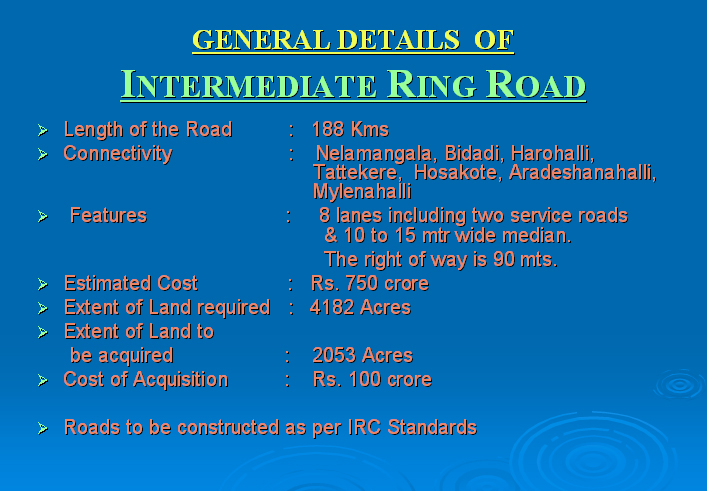
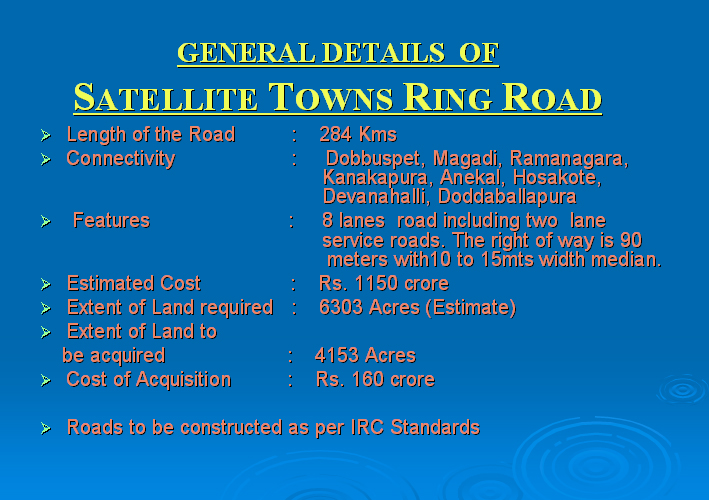
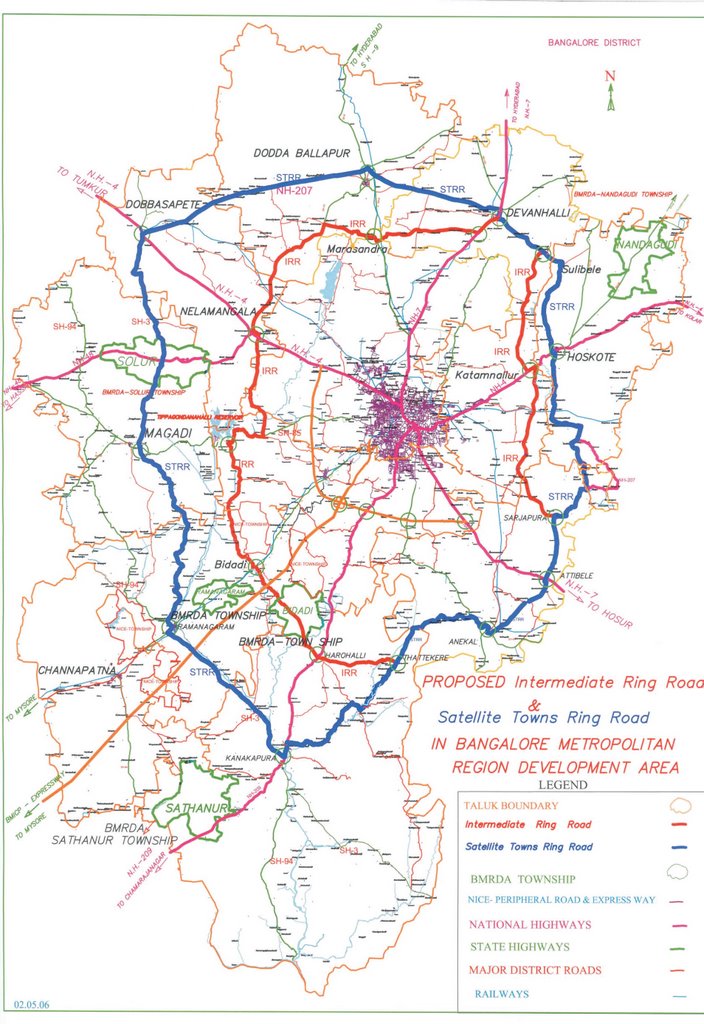
Bangalore new Ring Roads and townships

With the developement of Greater Bangalore here is schematic of the ring roads as they intersect various proposed satellite cities. Check out BMRDA Bangalore for more details


Super-luxury pads selling thick and fast

PREMIUM SPACES: Super luxury apartments are the latest in the city's realty scene. Courtesy: Vijay Shanthi Builders

Chennai's rich who are looking for the right living space have some fascinating options today.

Exclusive, super-luxury pads that offer cozy lifestyle, penthouses that add value to life and lifestyle, are the latest in Chennai's realty scene.

Villas and apartments that tap the power of technology to make life and living more comfortable are the pursuit of some of Chennai's big builders.

Massive price tags

Of course, they come with massive price tags, that hover around the Rs.1 crore mark. And know what? They are finding buyers, thick and fast!

For example, last month Vijay Shanti builders unveiled their super luxury offering - Patio - 15 exclusive apartments.

Each of these pads is spread across a floor space of 5,000 square feet each. The price tag: Rs. 4.25 crore each.

Peace and calm

Naresh Jain, Executive director of the building group, said that the architecture of the patio in Nungambakkam's Rutland Gate is French. The whole design is surrounded by the patio.

"For someone who can afford this, will look forward to peace and calmness. So we have provided for personal lifts for each house," he says. There is no staircase close to the living room. Instead the stairs are behind the utility area and kitchen.

With Vijay Shanthi's principle to build homes close to nature, bedroom spaces even those in the upper floors get a patch of greenery.

Symbols of luxury

Bathrooms too can be symbols of luxury, with their look, style and designer fittings. In this case, the bath is a massive affair - 14 ft. x 10 ft.

As the CEOs, IT employees and NRIs will already be members of some club or the other, the other amenities have been cut off in the apartments.

Instead a party space for 200 people has been added. The apartments have lumber room and a driver's room.

Each of the apartment space comprises four bedrooms, with a family and a formal living room. The 15 apartments have been spread on 22 grounds.

On four-acre plot

Now, Vijay Shanthi is coming up with a bigger project - apartments that will cost Rs. 8 crore each.

Another of their project is Club Cabana along the I.T corridor. A small community of 18 exclusively-styled villas that will cost Rs.1.25 crore each.

The project is to come up on a four-acre plot will have only 10 per cent built up area and the rest 90 per cent, a green spread.

Residents will have to park their cars near the gate and either walk, or bike or golf cart their way home through the greenery.

Courtyard

The project will begin in two months time. Vijay Shanthi's another project of this exclusive club is courtyard in Nungambakkam, Pycrofts Garden. Vishranthi Homes is another such building group specialising in high-end consumers.

Says Raghuram Reddy of Vishranthi, "Except one project Coconut Grove, all other projects in the city are above the Rs. 1 crore bracket."

Boom in IT/BPO sector

The boom in the I.T and ITES/BPO sectors is also leading to similar boom in the real estate sector, that too in that segment takinga tidy pay packet every month.

Christened "The Ferns", the first gated community international style exclusive villas, 10 minutes from the Siruseri complex on the IT corridor and five minutes from Kelambakkam and 25 minutes from Thiruvanmiyur is coming up on the East Coast Road in Thiruvidanthai Panchayat limits.

Out of the land area of 6.6 acres, 48 villas are to be built and along with the club house will occupy only 35 per cent of the total land area leaving 65 per cent to the private garden, well-laid out pathway and landscaped roads, children's play area and other common amenities.

Each villa will cost over Rs.85 lakhs and 17 villas have already been sold, explains D. Sudhakara Reddy, Chairman and Managing Director of Regaliaa Realty.

Designed as per Vastu

Each villa is designed by a Singapore architect keeping in mind the need of the present generation with a provision of an internet connection, home theatre system, modern security system, split air-conditioners and a family room and a partly covered terrace with a bar counter to entertain the guests in style.

The spacious living, dining and bedrooms are all designed to accommodate everything one fancies, Mr.Reddy said each villa has been designed as per Indian Vastu Sashtra combining with world class facilities.

Club house

A club house will also form part of the complex equipped with swimming pool with a toddlers pool and the support facilities seen in a high quality club house.

A jogging track, convenience store, a fitness centre, and an association office has also been planned.

Further details of the environmental-friendly villa project can be had from www.regaliaarealty.com

For those who can afford sky seems to be the limit and the developers are not complaining.

Sobha promoter in billionaire club

Sobha promoter in billionaire club
Kausik Datta / Mumbai December 21, 2006
P N C Menon, chairman of Sobha Developers, joined the billionaire club today, with the market value of his shares in his newly listed company touching Rs 6,135 crore.

Menon and his family hold 63.33 million shares, or 86.88 per cent stake in the company.

The stock today made a sparkling debut with a listing price of Rs 1,111.25 on the BSE — 74 per cent premium over the issue price of Rs 640. The stock reached the day’s high of Rs 1,179 and finally closed at Rs 968.75.

The 58-year old Menon, a commerce graduate, floated his real estate company 11 years ago in Bangalore with a paltry sum of Rs 7 crore. He began his professional career at the age of 24, by establishing an interior decoration firm in the Sultanate of Oman.

But his heart was always in India where he eventually returned and incorporated Sobha Developers, after his wife’s name.

Sobha Developer’s company’s maiden issue was 104 times subscribed. But Menon, it seems, wasn’t taking any chances A few days before the listing, he visited the Guruvayur Sri Krishna temple in Kerala and offered 70 kg of gold to the residing deity.

However, a close aide of Menon did not agree that Menon went to the temple because the listing was impending. “Menon has a home at Trichur which is only 10 kms away from Guruvayur. So whenever he visits Trichur, he goes to the temple,” he said.

His company has land reserves of 2,747 acres in Bangalore, Mysore, Pune, Chennai, Kochi, Thrissur and Coimbatore.

It has developed and constructed 21 residential projects in Bangalore covering 2.98 million sq ft, 75 contractual projects in eight Indian States covering about 8.42 million sq ft and two commercial projects aggregating 0.11 million sq ft.

Interest rates likely to go up further

New Delhi: If the government's mid-term review of the economy is an indication of its future strategy, then it's time to brace for further increase in interest rates and losing a few more bucks, thanks to the Centre's intent to prune tax exemptions.
There's a third shocker too, which the 68-page report tabled in Parliament talks about --changes in the subsidy regime, especially for food and cooking gas and kerosene -- but given the political opposition to the proposal, officials and economists say the chances are limited. Ditto for tax breaks on savings instruments but possibility of further increase in EMIs (equated monthly instalments) appears more realistic if the demand for loans does not taper off in the coming months and inflationary pressures continue.
The mid-term appraisal's emphasis on taking preemptive measures in response to inflationary pressures is what has prompted economists to say that monetary tightening exercise, through rate hikes, was not over yet.
Inflation — partly due to poor food production, and therefore supply, and the continued growth momentum — seems to be the biggest cause for concern in an otherwise rosy scene painted by finance minister P Chidambaram. At the same time, the government has tried to dispel the notion that the price rise is unprecedented. It has culled out data in an attempt to show that inflation was actually higher for most segments during the last fiscal. While the other alarm bells are largely predictable — agriculture and infrastructure (especially electricity) — low growth in labour-intensive sectors like leather, paper and food products, which have not kept pace with other industrial segments, is being articulated for the first time and at a time when the government expects a further period of sustained boom.
The mid-term review has used strong demand for capital goods and investment intentions rising 57% between between 2005 and October 2006 to predict that the period of high growth in the manufacturing sector, which started in 2004, is far from over.
The government has used this to make a case for reviewing inflexible labour laws as one major area of reform besides pushing the case for changing the rules of the game for banking, insurance and pension, where legislative changes have been held up due to opposition from the Left.